

Welcome back to Part 2 of our three-part Namibia road trip.
In Part 1, Brighde took us from Windhoek to Etosha National Park, with 4×4 travel, safari lodges, wildlife and plenty of behind-the-scenes scouting.
Now the landscape changes completely.
This part of the journey heads into rugged Damaraland before continuing west to the Skeleton Coast and Swakopmund. Along the way, there are desert-adapted elephants, ancient rock engravings, remote safari lodges, a night under the stars and one of the wildest temperature changes of the entire trip.
Into Damaraland
Leaving the flat plains around Etosha, the scenery begins to shift.
The land becomes rougher and more dramatic, with rocky ridges, dry riverbeds and huge granite boulders scattered across the desert.
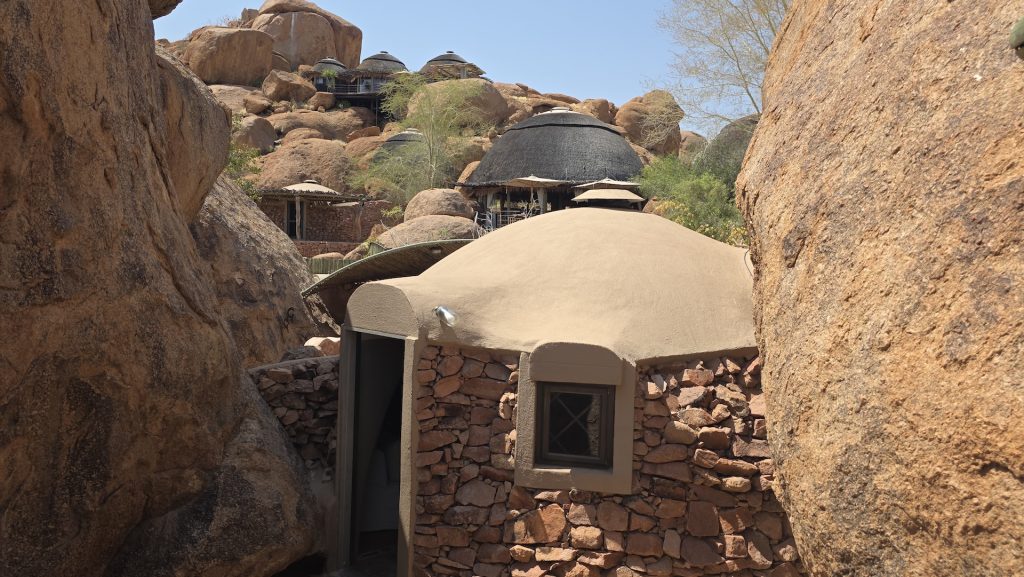
After several hours on the road, Brighde and Seb reached Mowani Mountain Camp, tucked between the rocks near Twyfelfontein.
The lodge blends into the landscape beautifully, with canvas and thatch rooms built around the natural boulders.
From the sundowner viewpoint, the views stretch across the desert in every direction.
Vegan Dining in a Remote Lodge
The setting was spectacular, but the first dinner was disappointing.
The vegan options lacked thought and, most importantly, did not include enough plant protein.
A beetroot starter arrived with goat’s cheese, while the main options were basic vegetable dishes with very little substance.
Brighde raised the issue with the lodge team and explained that remote location does not have to mean poor vegan food.
Staples such as lentils, chickpeas, beans and shelf-stable tofu are easy to store and can make a big difference to a plant-based meal.
The lodge team listened and promised to improve the following evening.
Tracking Desert-Adapted Elephants
The next morning brought one of the biggest highlights of Part 2.
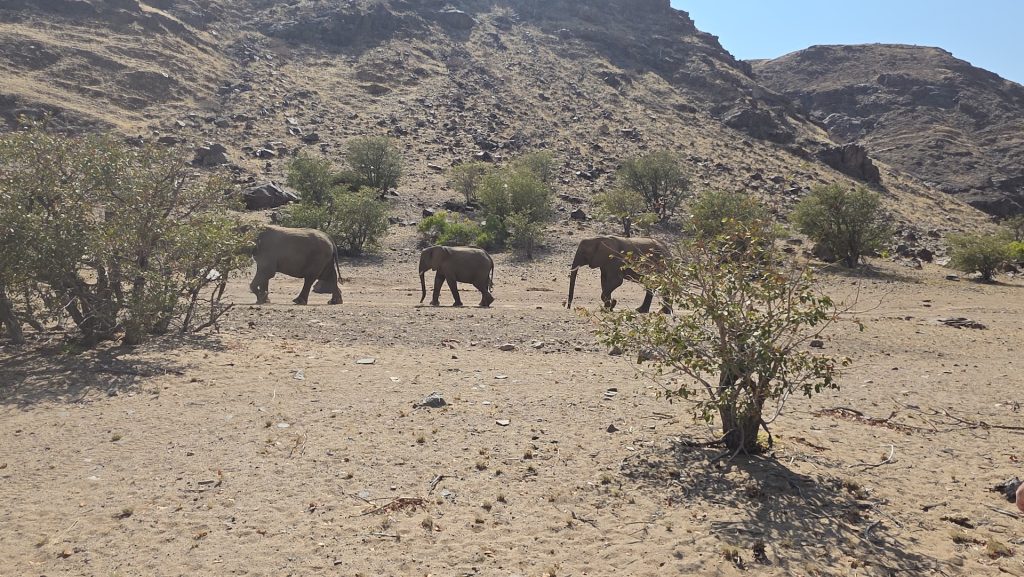
Brighde and Seb joined a guide to search for desert-adapted elephants in the dry Aba Huab riverbeds.
Finding them is not quick or easy.
The route involved driving through deep sand, dry channels and rough terrain while looking for signs of the herd.
After hours of tracking, they finally found elephants feeding in the riverine bush.
These elephants are not a separate subspecies. Instead, they are an ecotype of African savanna elephant that has adapted to life in an extremely dry environment.
Their survival depends on learned behaviour, long-distance movement and knowledge of hidden water sources passed down through generations.
Camp Kipwe and a Better Vegan Lunch
After returning to Mowani, Brighde and Seb visited nearby Camp Kipwe.
The property has a different feel, with earth-toned rooms built among lower granite boulders.
Lunch was also a welcome improvement.
Seb had a grain and vegetable bowl with tahini sauce, while Brighde enjoyed a fresh nacho salad.
After the previous meals, a properly balanced lunch was a very welcome change.
Twyfelfontein, Burnt Mountain and the Organ Pipes
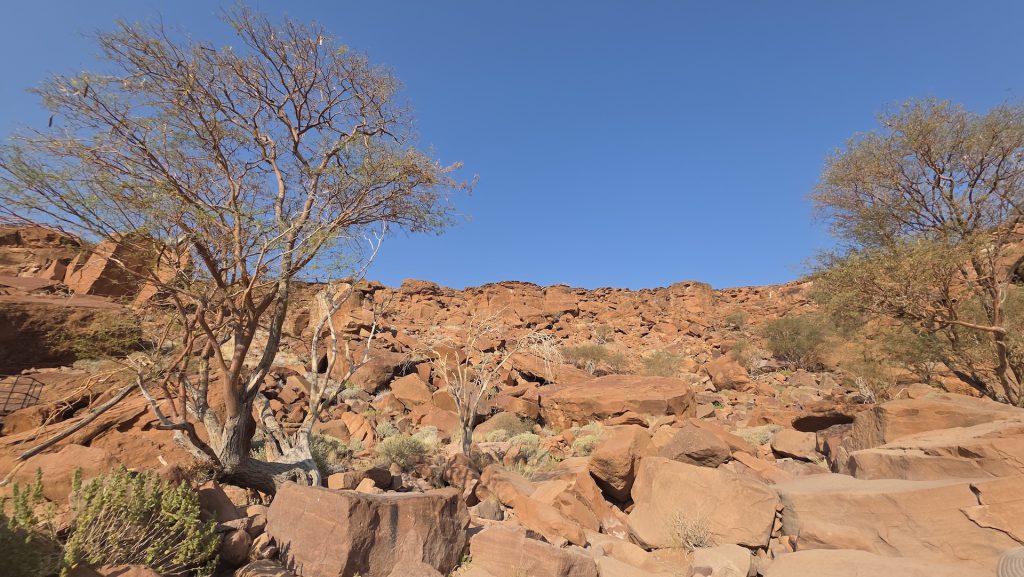
The afternoon was spent exploring some of Damaraland’s most important natural and cultural sites.
First came Burnt Mountain, a dark volcanic ridge formed by intense geological activity millions of years ago.
Nearby, the Organ Pipes reveal tall basalt columns created as ancient volcanic rock cooled and cracked.
The main stop, however, was Twyfelfontein.
Twyfelfontein is Namibia’s first UNESCO World Heritage Site and is home to thousands of ancient rock engravings.
Many were created by San hunter-gatherers and later Khoikhoi pastoralists.
These engravings were not simply decorative. They were used as records, survival maps and spiritual symbols.
One of the most famous images is the Lion Man, which combines human and animal features.
Seb’s Birthday Under the Stars
The next day was Seb’s birthday.
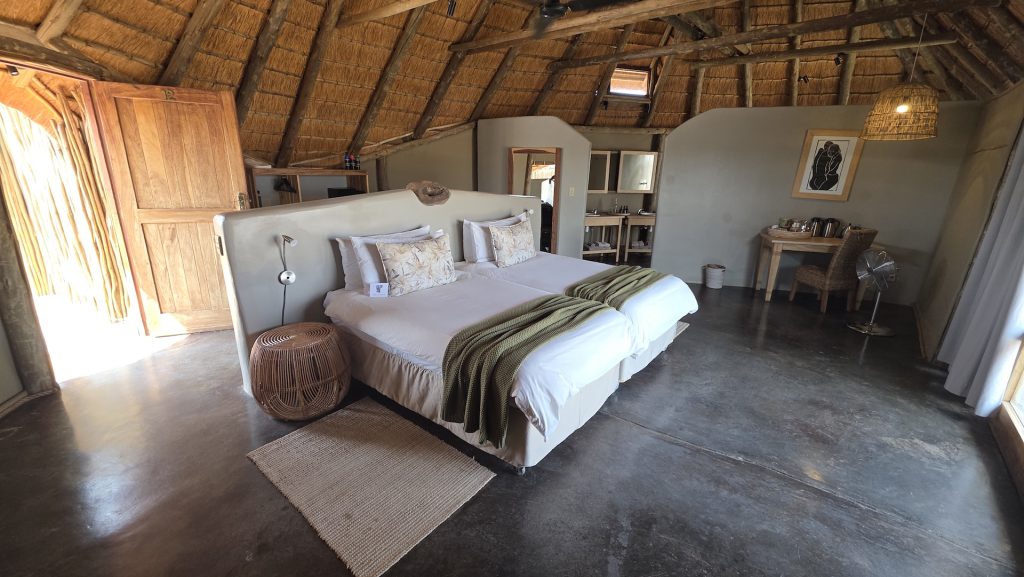
After leaving Mowani, Brighde and Seb travelled to Wilderness Doro Nawas.
The lodge sits above a wide desert valley and feels completely different from Mowani.
Later, they visited Wilderness Damaraland Camp to compare the two properties for future World Vegan Travel itineraries.
That evening, the staff surprised Seb with a vegan birthday cake, singing and dancing.
The celebrations continued with a short scorpion and stargazing tour.
Then came one of the most memorable experiences of the trip.
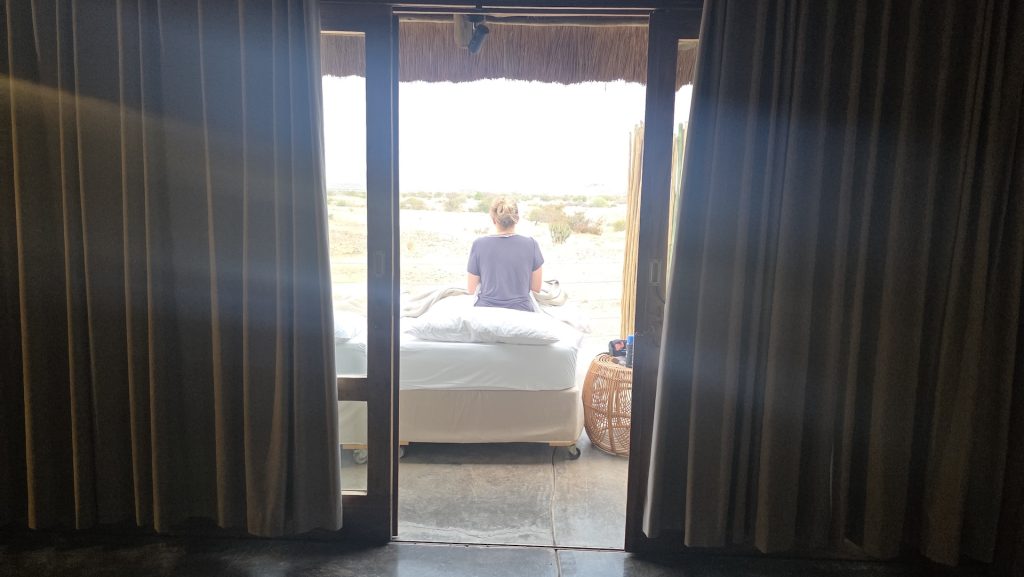
The beds at Doro Nawas can be rolled out onto the deck.
So Brighde and Seb slept outside under the southern stars, with the cool desert air around them.
It was a very special way to end Seb’s birthday.
A Wild Morning in the Desert
The next morning began peacefully but quickly turned chaotic.
Seb could not find his sunglasses.
Then strong winds swept across the valley and heavy rain arrived in the middle of the desert.
As they prepared to leave, their room key also disappeared.
It was eventually found inside the staff tip box after Seb had followed a sign saying “Place Keys Here” a little too literally.
It became one of the funniest moments of the trip.
From Desert Heat to Coastal Fog
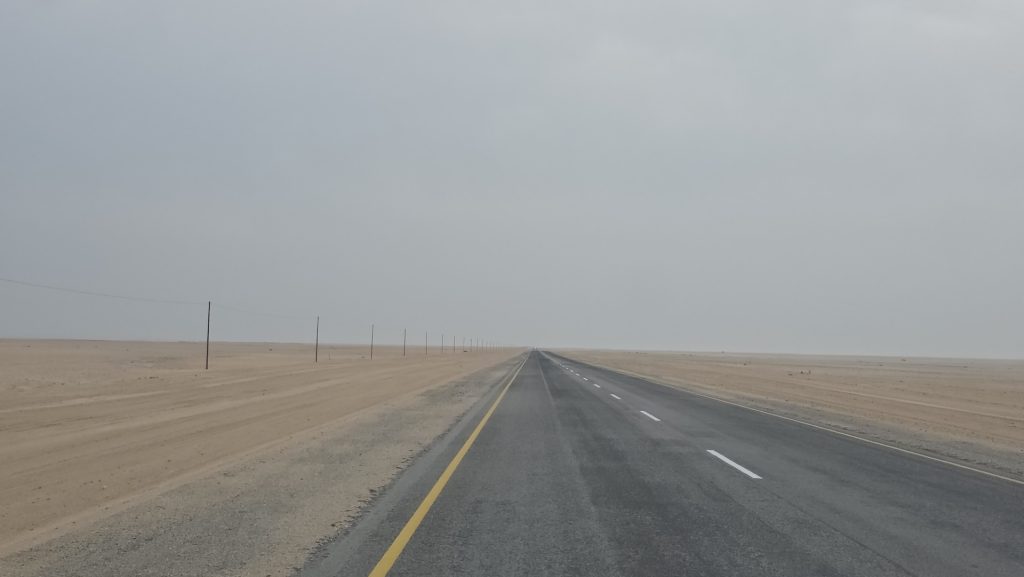
From Doro Nawas, the journey continued west toward the Atlantic coast.
Near Uis, the weather was still hot.
Then everything changed.
Within just a few minutes, the temperature dropped from around 32°C to 17°C as thick coastal fog moved in.
The dramatic change is caused by the cold Benguela Current, which brings icy ocean water north along the coast.
When that cold air meets the hot desert, heavy fog forms and temperatures can fall very quickly.
Cape Cross Seal Colony
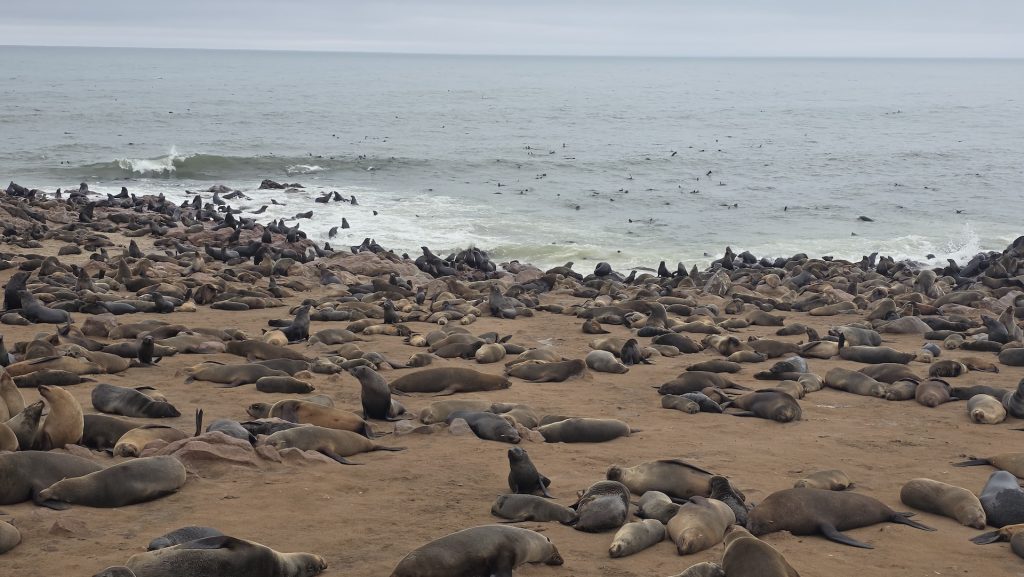
The next stop was Cape Cross.
It is home to one of the largest Cape fur seal colonies in the world.
The first thing visitors notice is the smell.
Then comes the noise.
Tens of thousands of seals cover the shoreline, barking, groaning and moving through the surf.
It is an unforgettable wildlife experience.
It is also a complex place because Namibia still allows an annual commercial seal cull, which remains controversial from an animal-welfare perspective.
Arriving in Swakopmund
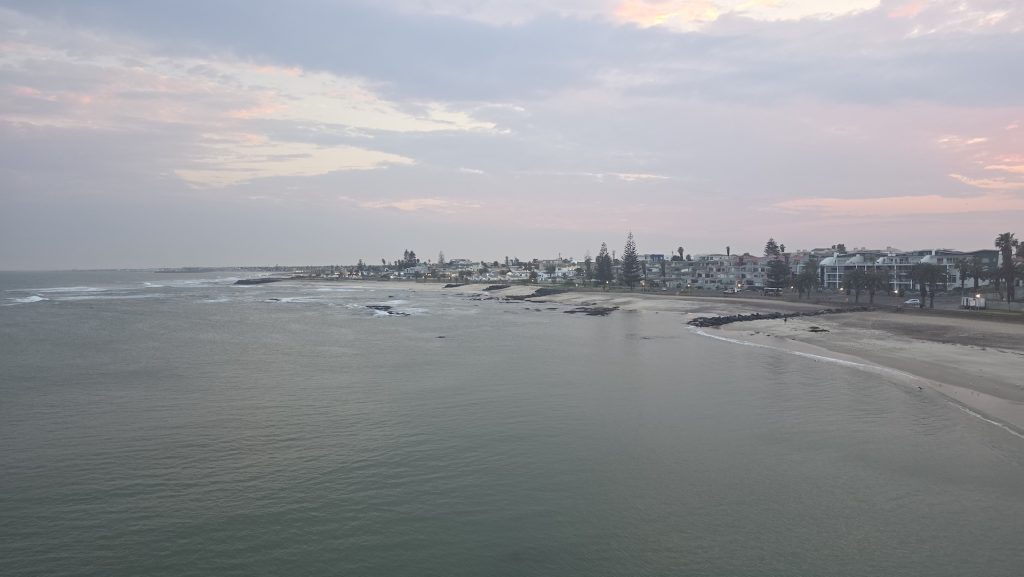
After Cape Cross, Brighde and Seb drove south along the coast toward Swakopmund.
The town feels completely different from inland Namibia.
Palm trees, German-style architecture and cool ocean air create a very different atmosphere.
They checked into the Strand Hotel Swakopmund, where their room overlooked the Atlantic.
The hotel chef had also prepared a special vegan menu for Brighde.
Her meal included wonton soup and a coconut vegetable curry, while Seb headed out for an Indian dinner nearby.
After several difficult vegan meals in remote lodges, it was a very welcome change.
The End of Part 2
Part 2 of the Namibia road trip brought some of the biggest contrasts of the entire journey.
There were ancient rock engravings, desert elephants, remote safari lodges, vegan food challenges, birthday celebrations, desert storms, freezing coastal fog and thousands of seals.
And the journey is not over yet.
In Part 3, the scenery changes again as Brighde heads deeper into the Namib Desert.
Expect red dunes, dramatic desert landscapes, aerial adventures and the final chapter of this Namibia scouting expedition.
Learn More About What is Discussed on the Podcast
- Twyfelfontein / Ui-//aes – Learn more about Namibia’s first UNESCO World Heritage Site and its remarkable concentration of ancient rock engravings. UNESCO World Heritage Centre
- Cape Cross Seal Reserve – Find out more about the Cape fur seal colony, the reserve and its wildlife. Ministry of Environment
- Skeleton Coast Park – Explore the stark Atlantic coastline, desert landscapes, coastal fog and wildlife of one of Namibia’s most remote regions. Ministry of Environment
- Dorob National Park – Learn more about the coastal desert landscape around Henties Bay and Swakopmund, including its lichen fields and Atlantic coastline. Ministry of Environment
- Swakopmund – Discover more about this coastal town, which combines German-influenced architecture with easy access to the Namib Desert and Atlantic Ocean. Visit Namibia
Other World Vegan Travel Content Connected With This Episode
- Namibia Road Trip Part 1: Windhoek & Etosha
- Namibia – There’s something for everyone! | Marike & Diaan Hoffman | Ep 109
- African Plant-Based Cuisine | Food, Culture & Tamu
- Elephant Conservation in South Africa | A Scientist’s Mission
- The First Plant-Forward Safari Lodge in Africa | Helene Sinisterra
- Exploring Vegan Hospitality in South Africa: An Interview with Marian from Old Joe’s Kaia
- The Timbavati, Game Reserve in South Africa – A Vegan Paradise | Hayley Cooper | Ep 114
- Five Best Places in South Africa to see The Big Five | Ingrid Geertsema | Ep 105
- S4 Ep2 Namibia – The Safari Destination You Need To Know About | JC De Klerk